
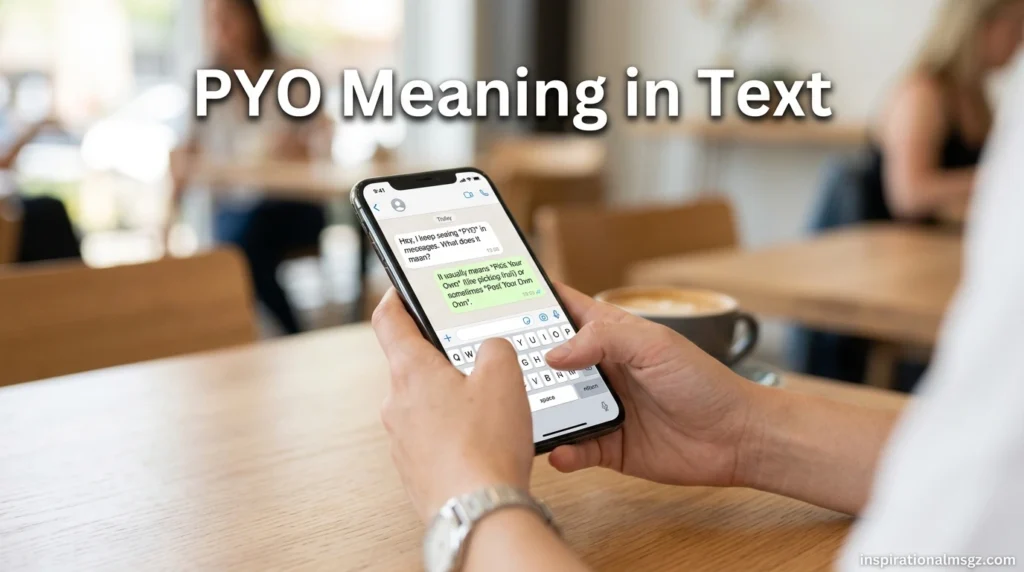
Ever been in the middle of a text conversation when someone drops “PYO” and you just… stare at your screen? You’re not alone. Slang moves fast, especially among teens and young adults who live half their social lives in DMs, group chats, and comment sections. New abbreviations pop up every week, and if you’re not chronically online, it’s easy to feel like you’re speaking a different language than your friends.
That’s exactly why so many people search “pyo meaning in text.” It’s short, it shows up everywhere from WhatsApp to TikTok, and it can quietly change the tone of a whole conversation if you misread it. Understanding internet slang isn’t just about sounding “cool” — it helps you avoid awkward misunderstandings, reply with confidence, and actually keep up with how modern digital conversations really work. This guide breaks PYO down completely, in simple, easy-to-follow English.
What Does PYO Mean in Text?
At its core, PYO is a texting abbreviation that most commonly stands for “Pick Your Own.” It’s used when someone wants to hand a decision over to you instead of making the choice themselves.
Think of it as the texting version of saying, “You choose” or “It’s up to you.” When a friend uses PYO, they’re usually being relaxed, flexible, and a little lazy in a friendly way — they don’t want to type out a full sentence when three letters will do the job.
In some conversations, especially in the U.S., PYO can also mean “Put You On,” which means introducing someone to something good — a song, a show, an app, a trend, or even another person. So the exact meaning always depends on the sentence around it, which is why context matters so much with slang like this.
Full Form and Short Meaning of PYO
Here’s a quick breakdown of the two most common expansions of PYO in texting:
- Pick Your Own – Giving someone the freedom to choose (most common meaning)
- Put You On – Recommending or introducing something/someone new
Both meanings share one thing in common: they’re about sharing control or sharing something valuable with another person. That’s part of why PYO feels friendly rather than cold or dismissive, even though it’s just three letters.
Why People Use PYO Instead of Typing It Out
People don’t use PYO because they’re too lazy to type — well, sometimes they are — but there’s more to it than that:
- It saves time in fast-paced group chats or comment sections
- It feels casual and relaxed, which matches the tone of most online conversations
- It signals familiarity, almost like an inside bit of texting culture shared between friends
- It avoids sounding bossy, since “PYO” feels softer than directly telling someone what to do
The Origin and Rise of PYO in Online Slang
Like a lot of internet abbreviations, PYO didn’t start as internet slang at all. The term “pick your own” has existed for decades in a completely different context — think PYO strawberry farms, pumpkin patches, or flower gardens, where visitors literally walk through a field and harvest their own produce. That older, literal meaning is still used today in agriculture and tourism.
Somewhere along the way, as texting and social media culture exploded, the phrase got shortened and repurposed. Instead of describing a farm activity, “pick your own” became a quick way to hand someone a choice in a text message. From there, TikTok and Instagram comment sections helped push it further into everyday slang, especially among Gen-Z users who love turning ordinary phrases into short, snappy abbreviations.
As short-form video content grew, so did the need for compact language that fits in captions, quick replies, and comment threads. PYO fit that need perfectly — three letters, instantly recognizable to anyone plugged into the trend, and flexible enough to use in almost any casual chat.
How PYO Is Used in Real Conversations
The best way to understand PYO’s slang meaning is to see it in action. Here are some natural chat examples showing how real people use it.
Example 1 – Deciding on plans
Friend 1: “Movie or bowling tonight?” Friend 2: “PYO, I’m down for either 😊”
Example 2 – Music recommendations
Person A: “Any song suggestions for the playlist?” Person B: “PYO honestly, I trust your taste”
Example 3 – Group chat decision
Group member: “Where should we eat, guys?” Reply: “PYO, just tell us the address lol”
Example 4 – Introducing something new
“Bro just PYO’d me to this new show and now I can’t stop watching it.”
In each case, PYO keeps the message short while still communicating something clear: either “you decide” or “I’m recommending this to you.”
Platform-Specific Meaning of PYO
While the core meaning of PYO stays fairly consistent, the way it’s used can shift slightly depending on the platform. Here’s how it typically shows up across the most popular apps.
PYO on WhatsApp
On WhatsApp, PYO is usually used in one-on-one or small group conversations between friends and family. Because WhatsApp chats tend to be more personal, PYO here often relates to everyday decisions — what to eat, what time to meet, or which option to pick for a shared plan.
“Should we go with the 6 PM or 8 PM show?” “PYO, either works for me!”
PYO on Instagram
On Instagram, PYO frequently appears in comments and DMs, especially when people are talking about outfits, filters, playlists, or recommendations. Influencers and casual users alike use it to keep replies short while still sounding friendly and engaged.
Comment: “Which caption should I use for this pic — PYO!”
PYO on TikTok
TikTok is where PYO really shines as trendy slang. Creators often use it in captions or pinned comments to invite viewers to choose something themselves, like a trend, sound, or outfit combination. It’s also common to see it used as shorthand for personalizing content.
Caption: “PYO which trend I try next 👇”
PYO on Snapchat
On Snapchat, PYO tends to show up in quick back-and-forth chats, often tied to spontaneous decisions like filters, Snap ideas, or plans for the day. Since Snapchat conversations are usually fast and casual, PYO fits naturally into that rhythm.
“Which filter for this Snap?” “PYO, they’re all cute anyway”
PYO’s Other, Unrelated Meanings
Slang meanings often collide with completely unrelated definitions from other fields, and PYO is no exception. It’s important to separate the internet slang usage from these other meanings so you don’t get confused.
- Medical/veterinary use: In medical and veterinary contexts, “pyo-” is a prefix related to pus or infection (as in “pyometra,” a uterine infection in dogs). This has nothing to do with texting slang and is a completely separate, clinical term.
- Agricultural/tourism use: As mentioned earlier, “PYO” is also a long-standing abbreviation for “Pick Your Own” farms, where visitors harvest their own fruit, vegetables, or flowers. This is a literal, non-slang usage still common in rural and seasonal contexts.
- Business/finance use: In some formal or workplace contexts, similar-looking acronyms can refer to unrelated business terms, so it’s worth checking context if PYO appears in a professional email rather than a casual chat.
If PYO shows up in a text from a friend, it’s almost certainly the slang meaning. If it shows up on a farm’s website or in a vet’s notes, it’s a completely different word altogether.
Common Confusions and What PYO Does NOT Mean
Because slang spreads quickly and inconsistently, PYO sometimes gets misread. Here are a few clarifications to keep in mind:
- PYO is not an insult. It’s a neutral, often friendly abbreviation, not a jab or a rude comment.
- PYO does not mean “leave me alone.” It’s about handing over a choice, not shutting down the conversation.
- PYO is not the same as “IDC” (I don’t care). While both can express flexibility, PYO is more about trust and giving someone freedom, whereas IDC can sometimes sound dismissive.
- PYO doesn’t always mean romantic interest. Some people assume it’s flirty by default, but in most chats, it’s simply casual and practical.
- PYO is not formal language. Using it in a professional email or a message to someone unfamiliar with slang can come across as confusing, so it’s best kept to casual texting with friends.
Similar Slang Terms and Related Abbreviations
If you’re learning PYO, it helps to know a few related terms that show up in similar contexts:
- IDC – “I don’t care,” used when someone is indifferent about a decision
- YKYK – “You know you know,” implying shared understanding
- NGL – “Not gonna lie,” used before an honest opinion
- WYD – “What you doing,” a casual check-in
- GTG – “Got to go,” used to end a conversation
- WSG – “What’s good,” a casual greeting
These terms often appear alongside PYO in the same kinds of casual, fast-paced conversations, so recognizing them together can help you follow group chats more easily.
How to Reply When Someone Says PYO
Knowing what PYO means is only half the equation — knowing how to respond keeps the conversation flowing naturally. Here are a few reply styles depending on the vibe you want.
Polite Replies
- “Sure, let’s go with [option]!”
- “Okay, I’ll pick then — how about this one?”
- “Thanks for letting me choose, I appreciate it!”
Flirty Replies
- “Aww, trusting me with the choice? I like that 😏”
- “PYO back at you, let’s decide together”
- “Careful, I might pick something wild 😄”
Boundary-Respecting Replies
If you’re not comfortable making the decision, or you’d rather not engage in a flirty tone, it’s completely fine to keep things neutral:
- “I’m okay with whatever, you can decide instead.”
- “Let’s just go with your idea, easier for both of us.”
- “I’d rather we pick together, what do you think works?”
There’s no single “correct” way to respond to PYO — the right reply depends on your relationship with the person and the tone of the conversation.
Is PYO Still Popular? Current Trends and Gen-Z Slang Culture
Slang terms usually follow a life cycle: they emerge, spread quickly, peak in popularity, and then either fade out or become a permanent part of everyday language. PYO currently sits somewhere in the middle of that cycle. It’s not as universally recognized as classics like “LOL” or “BRB,” but it remains active and relevant, especially within TikTok comment culture and Gen-Z texting habits.
Part of what keeps PYO alive is its usefulness — it fills a real gap in casual conversation by making it easy to hand over a choice without sounding demanding. As long as short-form video platforms keep encouraging compact, catchy language, terms like PYO are likely to stick around, even as new slang continues to emerge around them.
That said, slang culture moves fast, and it’s smart to always read the surrounding context rather than assuming a fixed meaning, since usage can shift depending on the group, platform, or region.
FAQs
What does PYO mean in a text message?
PYO usually means “Pick Your Own” in texting, and it’s used when someone wants to give you the freedom to choose instead of deciding for you.
What does PYO mean on TikTok?
On TikTok, PYO is often used in captions or comments to invite viewers to choose or personalize something themselves, like a trend, sound, or outfit.
Is PYO the same as “Put You On”?
Not exactly the same, but related. While “Pick Your Own” is the most common meaning, “Put You On” is a secondary meaning used when someone is recommending something new to you.
Is PYO used only by teenagers?
While PYO is especially popular among teens and young adults on social media, it can be used by anyone comfortable with casual texting slang, regardless of age.
Does PYO have a romantic meaning?
Not by default. PYO is generally a neutral, casual term, though it can take on a flirty tone depending on the context of the conversation and the relationship between the people texting.
Is it okay to use PYO in professional messages?
It’s best avoided in professional or formal communication. PYO is casual slang meant for friendly conversations, not workplace emails or official messages.
Conclusion
So, what does PYO mean in text? In short, it’s a casual texting abbreviation that most often stands for “Pick Your Own,” used when someone wants to give you the freedom to make a decision, whether that’s about food, plans, music, or content. It can also mean “Put You On” when someone is recommending something new. You’ll spot it most often on WhatsApp, Instagram, TikTok, and Snapchat, usually in relaxed, friendly conversations rather than formal ones.
The next time PYO shows up in your messages, you’ll know exactly what’s being asked of you — and you’ll have plenty of natural ways to reply, whether you want to keep things polite, playful, or simply straightforward. Understanding small slang terms like this one makes it a lot easier to keep up with how people actually talk online today.