
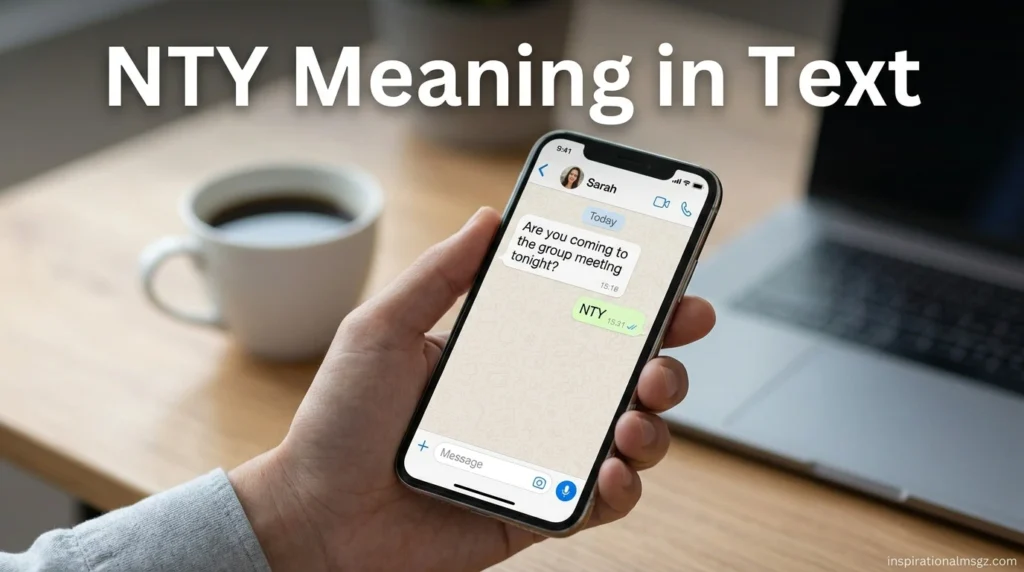
If you’ve been scrolling through WhatsApp, Instagram DMs, or TikTok comments and suddenly spotted the letters “NTY,” you’re not alone in wondering what it means. Texting culture moves fast, and new abbreviations pop up almost every week, making it easy to feel lost in a conversation full of shortcuts.
People search for “NTY meaning in text” because context alone often isn’t enough — the same three letters can carry a completely different tone depending on who sends them and where. Understanding internet slang isn’t just about keeping up; it helps you avoid awkward misunderstandings, respond appropriately, and feel more confident in digital conversations. In this guide, you’ll learn exactly what NTY means, where it came from, how to use it, and how to reply when someone sends it to you.
What Does NTY Mean in Texting and Online Chat?
NTY is a short, casual abbreviation used in everyday digital conversations. It’s the kind of slang you’ll find in quick replies, comment sections, and group chats where speed and brevity matter more than full sentences.
At its core, NTY is a polite-but-short way of declining something or turning down an offer, similar to saying “no thanks” but in fewer keystrokes. It’s part of a much bigger family of texting shortcuts that trade full words for quick letter combinations, allowing conversations to move faster without losing meaning.
Full Form and Short Meaning
The full form of NTY is:
- N – No
- T – Thank
- Y – You
So, NTY simply stands for “No, Thank You.”
It’s used exactly the way you’d use the phrase in real life — as a polite refusal — just compressed into a texting-friendly format. The short meaning is simple: someone is saying no, but doing it in a courteous, non-rude way.
Why People Use Abbreviations Like NTY
Texting culture rewards speed. Whether you’re replying to a friend, commenting on a TikTok, or messaging in a group chat, typing out full sentences can feel slow. Abbreviations like NTY exist because they:
- Save time while typing on small keyboards
- Keep the tone casual and friendly
- Fit naturally into fast-paced chat threads
- Match the rhythm of how Gen Z and younger millennials communicate online
The Origin and Rise in Popularity of NTY
Like most texting slang, NTY didn’t appear overnight in a dictionary — it grew organically from the same pattern that gave us terms like “TY” (thank you), “NP” (no problem), and “IDK” (I don’t know). As texting and instant messaging became the dominant form of daily communication, people naturally started shortening common polite phrases.
“No, thank you” is one of the most frequently typed polite responses in everyday chatting — used to decline invitations, offers, requests, or suggestions. Because it’s said so often, it was only a matter of time before someone shortened it, and the abbreviation spread through group chats, comment sections, and messaging apps.
Its popularity grew alongside:
- The rise of mobile-first messaging (WhatsApp, iMessage, SMS)
- The explosion of short-form social media (TikTok, Instagram Reels)
- A broader cultural shift toward quick, casual digital communication
Today, NTY sits comfortably among other everyday chat abbreviations, especially in casual and semi-casual conversations between friends, acquaintances, and even in customer-facing chats where a fast, polite “no” is needed.
How NTY Is Used in Real Conversations
The best way to understand NTY meaning in text is to see it in action. Below are natural chat examples showing how it typically appears.
Example 1 – Declining an Invitation
Friend: “Wanna come to the party tonight?” You: “NTY, I’m exhausted today 😅”
Example 2 – Turning Down an Offer
Friend: “Want me to save you a seat?” You: “NTY, I’ll just stand, it’s fine!”
Example 3 – Responding to a Suggestion
Friend: “You should try this new app, it’s addictive.” You: “NTY lol, I already waste enough time on my phone”
Example 4 – In a Group Chat
Group member: “Anyone want extra tickets?” You: “NTY, already got mine!”
Notice how NTY keeps the tone light and non-confrontational. It’s not blunt or rude — it reads almost like a smaller, chat-friendly version of a polite decline.
How NTY Is Used on Different Platforms
While the core NTY meaning in text stays consistent, how it’s used can shift slightly depending on the platform.
NTY on WhatsApp
On WhatsApp, NTY is mostly used in one-on-one or group chats between friends and family. Since WhatsApp conversations tend to be more personal, NTY here usually keeps its original, polite “no thank you” meaning — often followed by a reason or an emoji to soften the tone.
“NTY, I already ate 🍕”
NTY on Instagram
On Instagram, especially in DMs and comment replies, NTY often appears in quick reactions to offers, tags, or requests — like turning down a shoutout, a follow-for-follow request, or a promotional DM.
“Thanks for the offer, but NTY 🙏”
NTY on TikTok
The NTY meaning on TikTok is largely the same, but it shows up frequently in comment sections — replying to challenges, trends, or invitations within duets and stitches. TikTok’s fast comment culture makes short slang like NTY extremely common.
Comment: “Do the trend with me!” Reply: “NTY, not my vibe 😂”
NTY on Snapchat
On Snapchat, where conversations are quick, disappearing, and informal, NTY is used almost identically to WhatsApp and Instagram — a fast, casual decline, often paired with a snap reaction or emoji instead of a lengthy explanation.
NTY vs Unrelated Meanings: Avoiding Confusion
Slang abbreviations often overlap with unrelated acronyms used in different contexts, and NTY is no exception. It’s important to separate the texting slang meaning from other unrelated uses of similar-looking abbreviations you might come across online, in gaming, or in formal contexts.
- In texting and social media, NTY almost always means “No, Thank You.”
- In unrelated technical, gaming, or organizational contexts, similar-looking acronyms may stand for entirely different terms specific to that field, industry, or platform — and have nothing to do with declining something politely.
If you see NTY in a casual chat, comment section, or DM, it’s safe to assume the texting slang meaning applies. If it appears in a completely different context (like a technical manual, gaming forum with specialized terms, or a formal document), it likely refers to something unrelated, and you should judge it based on that specific context rather than assuming the “no thank you” meaning.
Common Confusions and What NTY Does NOT Mean
Because slang spreads quickly and inconsistently, people sometimes misread NTY. Here’s what it does not mean:
- ❌ It does not mean “Not Today, Yet”
- ❌ It does not mean “New To You”
- ❌ It is not a rude or aggressive way of saying no
- ❌ It’s not typically used as a formal or professional response
- ❌ It doesn’t imply sarcasm unless the surrounding tone/emojis suggest it
Key takeaway: NTY is almost always a shortened, casual, and polite version of “No, thank you.” Any other interpretation usually comes from confusing it with a different, unrelated acronym.
Similar Slang Terms and Related Abbreviations
If you’re learning NTY, it helps to know the abbreviations it’s often used alongside:
- TY – Thank you
- NP – No problem
- YW – You’re welcome
- IDC – I don’t care
- IDK – I don’t know
- NVM – Never mind
- JK – Just kidding
- IMO – In my opinion
These all belong to the same family of quick, polite, or casual texting shortcuts that help conversations flow faster without sounding cold or overly formal.
How to Reply When Someone Says NTY
Knowing the NTY meaning in text is only half the picture — knowing how to respond naturally is just as important. Here are a few approaches depending on the vibe of the conversation.
Polite Responses
- “No worries at all!”
- “All good, maybe next time 😊”
- “Totally understand!”
Flirty Responses (if the context is playful)
- “Aww, playing hard to get? 😏”
- “Fine, but you’re missing out 😉”
- “Noted, I’ll ask again later 😄”
Boundary-Respecting Responses
- “That’s completely fine, thanks for letting me know.”
- “No pressure, appreciate the honesty.”
- “Got it, respect that 🙌”
The right response really depends on your relationship with the sender. With close friends, a light, teasing reply usually works. With acquaintances or in more neutral contexts, a simple, respectful acknowledgment is the safest choice.
Is NTY Still Popular? Current Trends and Gen-Z Slang Culture
Texting slang trends rise and fall quickly, so it’s fair to ask whether NTY is still relevant. The short answer: yes, though it’s more of a steady, everyday abbreviation than a viral, trend-driven term.
Unlike slang that explodes overnight because of a meme or a TikTok sound, NTY has stayed consistently useful because it solves a simple, everyday problem — declining something quickly and politely. It fits naturally into:
- Casual friend group chats
- Comment replies on social platforms
- Quick DM exchanges
- Everyday texting between peers
While Gen-Z slang culture constantly introduces flashier, more expressive terms, practical abbreviations like NTY tend to stick around because they’re functional rather than trend-dependent. It’s less “viral slang” and more “quiet staple” of digital communication — the kind of term that doesn’t need a trend to stay relevant.
FAQs
What does NTY mean in a text message?
NTY stands for “No, Thank You.” It’s a quick, casual, and polite way of declining an offer, invitation, or suggestion in a text conversation.
Is NTY a rude way to say no?
No, NTY is not meant to be rude. It’s simply a shortened version of a polite phrase, and its tone usually depends on the emojis or context surrounding it rather than the abbreviation itself.
What is the NTY meaning on TikTok?
On TikTok, NTY carries the same meaning as elsewhere — “No, Thank You” — and is commonly used in comment sections to politely decline a trend, challenge, or suggestion.
Can NTY be used in professional or formal messages?
Generally, no. NTY is casual internet slang best suited for friendly, informal conversations. In professional settings, it’s better to write out “No, thank you” in full.
What’s the difference between NTY and NP?
NTY means “No, Thank You” (a polite decline), while NP means “No Problem” (a casual way of accepting something or brushing off an apology). They’re used in very different situations.
Does NTY always mean the same thing on every platform?
In texting and social media platforms like WhatsApp, Instagram, TikTok, and Snapchat, NTY consistently means “No, Thank You.” Only in unrelated technical or specialized contexts might a similar-looking acronym mean something else.
Conclusion
So, what does NTY mean in text? At its heart, it’s simply a fast, casual way of saying “No, Thank You” — a small abbreviation that fits perfectly into today’s quick-paced digital conversations. Whether you spot it on WhatsApp, Instagram, TikTok, or Snapchat, the meaning stays largely the same: a polite, low-key decline rather than a rude dismissal.
Now that you understand its full form, origin, and how it’s used across different platforms, you can confidently recognize it in conversations and reply in a way that matches the tone — whether that’s a polite acknowledgment, a playful tease, or a respectful “no worries.” Like most texting slang, NTY isn’t complicated once you know the context — it’s just a small shortcut that helps digital conversations feel a little faster and a little friendlier.