
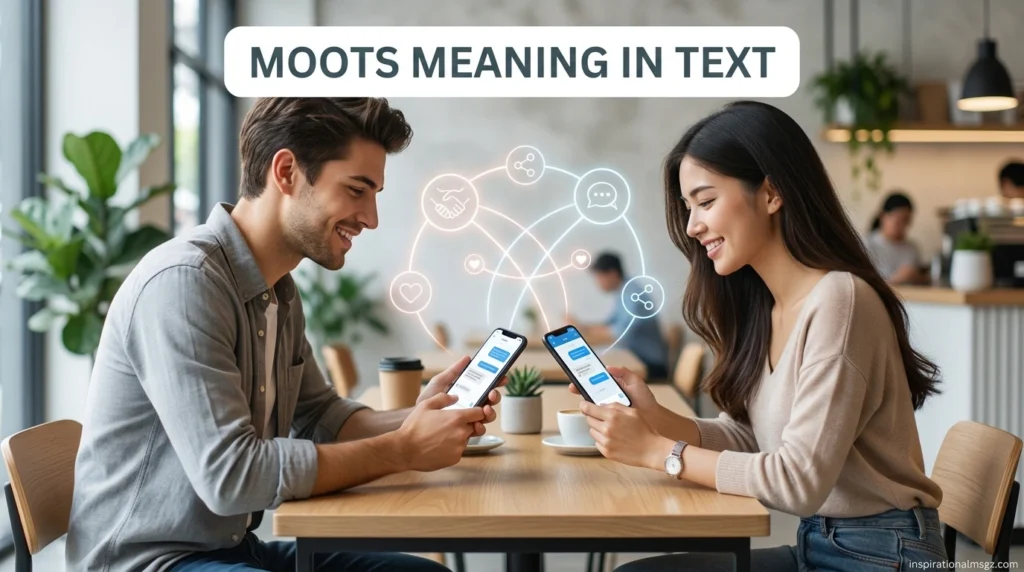
If you’ve been scrolling through Instagram, TikTok, or Twitter (X) and spotted the word “moots” in someone’s bio, comments, or DMs, you’re probably wondering what it actually means. You’re not alone. This word pops up everywhere in online chats, especially among Gen Z users, but it’s rarely explained anywhere obvious. That’s exactly why so many people search for “moots meaning in text” every single day.
Understanding slang like this matters more than it seems. Internet language changes fast, and terms like “moots” carry a whole social context behind them — they’re about friendship, connection, and belonging in online spaces. Missing the meaning can make you feel left out of a conversation, or worse, make you reply the wrong way. This guide breaks down everything simply: the full meaning, where it came from, how it’s used on different apps, and exactly how to respond when someone calls you their “moot.”
What Does “Moots” Mean in Texting?
In texting and online chat, “moots” is short for “mutuals.” A mutual is someone who follows you and whom you follow back on a social media platform — basically, a two-way online connection. So when someone says “you’re my moot,” they’re simply saying “we follow each other” or “we’re mutually connected online.”
The slang meaning is casual and friendly. It’s not usually romantic (though it can turn flirty depending on context), and it’s not a formal term at all. It’s simply internet shorthand for describing a specific type of online relationship — one built through likes, comments, and shared community rather than necessarily knowing someone in real life.
Full Form and Short Meaning
- Full form: Mutuals (people who follow each other back)
- Short slang form: Moots
- Singular use: “moot” (one mutual)
- Plural use: “moots” (multiple mutuals)
- Part of speech: Noun (sometimes used loosely as an adjective, like “moot energy”)
So if a friend texts you “we’re moots now,” it simply means you both follow each other and are officially part of each other’s online circle.
Quick Definition Box
Term Meaning Moot (singular) One person who follows you and is followed back Moots (plural) A group of mutual followers/friends online Mooting The act of interacting or following each other Moot mode Being extra social/active with your mutuals
Where Does “Moots” Come From? Origin and Rise in Popularity
The word “moots” comes directly from “mutuals,” a term that has existed on platforms like Twitter and Tumblr for over a decade. In its earliest days, “mutual” simply described the technical relationship of two accounts following each other back.
Over time, especially within fandom communities (K-pop stans, anime fans, gaming communities), “mutual” got shortened for speed and casual tone — the way “totally” became “totes” or “probably” became “probs.” “Moots” became the fun, friendly version of “mutuals,” and it stuck.
The term really exploded in popularity with the rise of stan Twitter culture in the mid-2010s, where having “moots” wasn’t just about following each other — it meant being part of a tight online friend group that talked daily, supported each other’s posts, and sometimes even became real-life friends. From there, the word spread naturally to Instagram, TikTok, and Discord as those platforms grew their own community-driven cultures.
Today, “moots” is considered mainstream internet slang, especially among teens and young adults who are active in online fan spaces, gaming communities, or content creation circles.
Why the Word Stuck Around
Slang words usually fade fast, but “moots” has lasted for a reason: it describes something that didn’t have a short, catchy name before. “Mutual follower” is accurate but clunky to type over and over in a fast-moving chat or comment section. “Moots” solved that problem — it’s quick to type, easy to say out loud, and instantly recognizable within online communities.
It also helped that the word feels warm and inclusive. Unlike terms like “follower” or “fan,” which can feel one-sided or distant, “moot” implies mutual effort — both people chose to connect with each other. That small emotional difference is part of why the word became so popular among younger users who value community and belonging in digital spaces.
Why People Search for “Moots Meaning in Text”
If you landed on this article after typing “moots meaning in text” into Google, you’re probably one of a few types of people:
- Someone who saw the word in a text, comment, or bio and had no idea what it meant
- A parent or older sibling trying to understand a younger family member’s messages
- A non-native English speaker learning modern internet vocabulary
- Someone new to platforms like TikTok, Instagram, or Discord who keeps seeing unfamiliar slang
This is completely normal. Internet slang evolves so fast that even people who grew up online can feel out of the loop sometimes. The good news is that once you understand a term like “moots,” it becomes easy to recognize in almost any context — texting, comments, captions, or bios — because the meaning barely changes across platforms.
How “Moots” Is Used in Real Conversations
Understanding the definition is one thing, but seeing it in action makes it click faster. Here are some natural examples of how “moots” shows up in everyday chats.
Example Chat 1: Meeting Someone New Online
User A: hey! love your edits, mind if I follow? User B: omg yes please, let’s be moots 🥹
Here, “let’s be moots” simply means “let’s follow each other and stay connected.”
Example Chat 2: Catching Up
User A: it’s been so long since we talked User B: ikr, my moots from last year all went quiet lol
This shows “moots” used to describe an existing online friend group that has gone inactive.
Example Chat 3: Asking for Support
User A: just posted a new video, can my moots please watch 🙏 User B: on it right now!
This is a very common way “moots” is used — as a casual call for support from your online circle.
Example Chat 4: Bio Usage
A typical Instagram or Twitter bio might read:
“mutuals only 💗 mooting daily, always here for my moots”
This tells other users the account is focused on building genuine follower relationships rather than just gaining random followers.
Platform-Specific Meaning of “Moots”
While the core meaning of “moots” stays the same everywhere, the way it’s used slightly shifts depending on the platform. Here’s a breakdown.
Moots Meaning on WhatsApp
WhatsApp doesn’t have a public follower system like Instagram or Twitter, so “moots” isn’t a native WhatsApp term. However, people still use it in WhatsApp chats when talking about their online mutuals from other apps. For example:
“one of my Twitter moots just texted me on WhatsApp, we’re actually becoming real friends now”
So on WhatsApp, “moots” usually refers to a connection that started elsewhere and moved into private messaging.
Moots Meaning on Instagram
On Instagram, “moots” is extremely common, especially in bios, comment sections, and close friends stories. It typically means two accounts that follow each other and regularly engage — liking posts, replying to stories, or commenting. You’ll often see phrases like:
- “New moot alert 🎉”
- “Looking for moots, mutual follow?”
- “My Instagram moots are the best part of this app”
Moots Meaning on TikTok
TikTok’s meaning is very similar, but it leans more toward creators and their supportive community. “Moots” on TikTok often refers to fellow creators who comment on and share each other’s videos, almost like an informal support network. A comment might say:
“my moots really showed up for this video, love you guys”
This shows the community and support-based meaning of “moots” on TikTok.
Moots Meaning on Snapchat
Snapchat usage is a bit more personal since it’s built around close, private communication. Here, “moots” usually refers to people you follow each other with on Snapchat and actively snap or chat with regularly — not just random adds. It carries a slightly closer, more intimate tone than on Instagram or TikTok.
Moots Meaning on Twitter/X
It’s worth mentioning Twitter/X separately, since this is actually where the word “moots” first became popular. On this platform, a “moot” is a mutual follower you regularly interact with — replying to tweets, quote-tweeting, or joining group chats together. Twitter/X communities, especially fan and stan accounts, often treat their “moots list” as a genuine online friend group, sometimes even organizing group calls or meetups with people they’ve never met in person.
A Quick Comparison Table
Platform Typical Tone of “Moots” Twitter/X Origin platform; close-knit fan/community friendships Instagram Casual mutual followers, bio culture, story interactions TikTok Creator-to-creator support and engagement Snapchat More personal and private connections WhatsApp Refers to mutuals from other apps, moved to private chat
“Moots” vs. “Moot” (Unrelated Meanings): Don’t Get Confused
This is where a lot of confusion happens, especially for non-native English speakers or anyone unfamiliar with slang. The word “moot” also exists in standard English, and it has a completely different, unrelated meaning.
Standard English Meaning of “Moot”
In formal English, “moot” describes something that is debatable, or a point that is no longer relevant or worth discussing. For example:
- “The plan is a moot point now that the deadline passed.”
- “It’s moot whether we should even continue this project.”
In law schools, a “moot court” is also a practice courtroom exercise for students.
Key Difference to Remember
Context Meaning Slang / texting / social media Mutual follower or online friend Formal English Debatable or no longer relevant Legal / academic Practice court exercise (“moot court”)
So if you see “moot” in a legal article or academic essay, it has nothing to do with followers or online friendships. Context is everything here — always check where the word is being used before assuming its meaning.
Common Confusions and What “Moots” Does NOT Mean
Since the word is casual slang, people sometimes misread its tone or intent. Here’s what “moots” does not mean:
- It doesn’t automatically mean romantic interest. Calling someone your “moot” is about online connection, not flirting — although it can turn flirty depending on the relationship.
- It doesn’t mean a close real-life friend by default. Some moots are strangers you’ve never met, though friendships can grow from it.
- It’s not the same as “follower.” A follower is one-directional; a “moot” specifically means both people follow each other.
- It’s not a demand or obligation. Being asked to “moot” someone is a friendly invitation, not a requirement.
- It’s not always positive slang everywhere. In some formal or professional writing, using “moot” the internet way could confuse readers expecting the standard English meaning.
Similar Slang Terms and Related Abbreviations
If you’re learning “moots,” these related terms will likely come up too:
- Mutual(s) – the full, non-slang version of “moots”
- Moot mode – being very active and social with your online circle
- Stan – an intensely dedicated fan, often used alongside “moots” in fan communities
- Fam / squad – general slang for a close online or offline friend group
- Internet BFF – an online friend who feels as close as a real-life best friend
- Follow back / F4F – “follow for follow,” a common way people request to become moots
- Mutuals only – a bio phrase meaning the account only wants genuine two-way followers
Knowing these related terms helps you understand the wider vocabulary of online friendship slang, not just the one keyword.
Alternatives to the Word “Moots”
Depending on the platform or community, you might also hear these alternative phrases used with a similar meaning:
- “My people” – a broader, warmer way to describe your online community
- “Online fam” – similar meaning to moots, slightly more casual
- “Twt friends” / “IG friends” – platform-specific ways to describe the same idea
- “Circle” – a general term for a close online group, not always mutual-based
- “Support system” – often used by creators to describe moots who consistently engage with their content
None of these are exact one-to-one replacements, but they overlap enough that understanding “moots” makes all of them easier to recognize too.
How to Reply When Someone Says “Moots” to You
Not sure how to respond when someone calls you their moot or asks to become moots? Here’s a simple guide depending on the tone you want to set.
Friendly / Neutral Replies
- “Aww yes, moots forever 💕”
- “Let’s do it, following you now!”
- “Glad we’re moots, your content is so good”
Polite Replies (If You’re Not Sure Yet)
- “Thanks so much! I’ll check out your page first 😊”
- “That’s sweet of you, let’s stay connected here”
- “I appreciate that, I’ll follow back soon!”
Flirty Replies (Only If You’re Comfortable)
- “Best moot I could ask for 😏”
- “Careful, I might become your favorite moot”
- “Moots with benefits? Kidding… unless 👀”
Boundary-Respecting Replies (If You Want to Decline Politely)
- “I appreciate it, but I’m keeping my following list small right now”
- “Thank you, but I only follow accounts I’m already close with”
- “That’s kind of you, but I’ll pass for now — no hard feelings!”
The key is matching your reply to your comfort level. “Moots” is a low-pressure term, so there’s no wrong way to respond as long as you’re being genuine.
Is “Moots” Still Popular? Current Trends in Gen-Z Slang
Yes — “moots” remains very much alive in 2026 internet culture. While slang trends move quickly, “moots” has stayed relevant because it fills a real gap: there wasn’t an easy, casual word for “mutual follower” before it became popular, and nothing has fully replaced it since.
It’s especially common in:
- Fan and stan communities (K-pop, anime, gaming)
- Content creator spaces on TikTok and Instagram
- Discord servers built around shared interests
- Twitter/X communities with tight-knit follower circles
While platforms and trends shift constantly, “moots” has proven to be one of the more stable pieces of Gen-Z vocabulary — it’s simple, useful, and easy to understand once explained, which is part of why it keeps getting passed down to newer users joining these platforms.
Why It Keeps Getting Passed Down
Unlike trend-based slang that dies out after a viral moment (think one-off TikTok sounds or memes), “moots” survives because it’s functional slang — it describes a real, ongoing relationship type that exists on every major platform. As long as social media has follow buttons and comment sections, there will likely be a casual word for “people who follow each other back,” and right now, that word is “moots.”
New users joining Instagram, TikTok, or Discord for the first time tend to pick up the term quickly just by seeing it used in bios and comments, which keeps it circulating naturally without needing viral moments to stay relevant.
FAQs
What does “moots” mean in slang?
“Moots” is slang for “mutuals” — people who follow each other back on social media and often interact regularly through likes, comments, or messages.
What is the full form of “moots”?
The full form of “moots” is “mutuals,” referring to a two-way follow relationship between two social media accounts.
What does “moots” mean on TikTok?
On TikTok, “moots” usually refers to fellow creators or followers who mutually support each other’s content through comments, shares, and engagement.
Is “moots” a romantic term?
Not by default. “Moots” simply describes an online mutual connection, though it can become flirty depending on how two people use it with each other.
Is “moot” the same as “moots”?
“Moot” (singular) usually refers to one mutual follower, while in formal English, “moot” also means something debatable or no longer relevant — a completely different, unrelated meaning.
How do you become someone’s “moot”?
You become someone’s “moot” simply by following each other back on a platform like Instagram, TikTok, or Twitter/X, often after interacting through comments or DMs first.
Conclusion
So, what does “moots” mean in text? In short, it’s internet slang for “mutuals” — people who follow each other back and often build friendly, supportive online relationships through likes, comments, and shared interests. It’s different from the formal English word “moot,” which means something debatable, so context always matters when figuring out which meaning applies.
Whether you see it on Instagram, TikTok, Snapchat, or in a WhatsApp chat about your online friends, “moots” is a light, friendly term rooted in digital community culture. Now that you know its meaning, origin, and how to respond to it, you can use it confidently — and maybe even make a few new moots of your own along the way.