
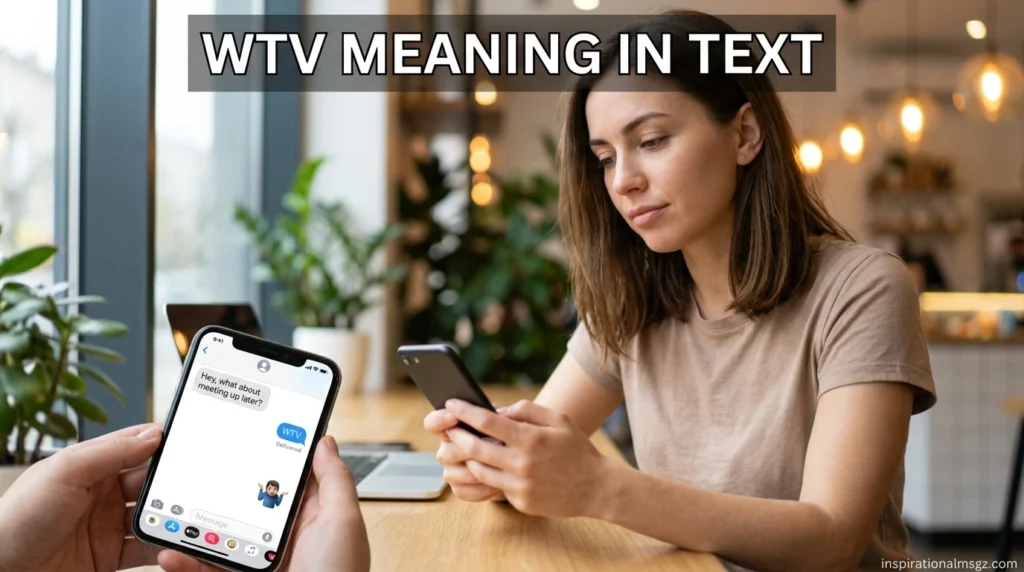
If you’ve ever received a text that just said “wtv” and wondered whether the person was annoyed, bored, or just being casual, you’re not alone. Thousands of people search for “wtv meaning in text” every month because this short abbreviation shows up everywhere — in group chats, comments, DMs, and captions — and its tone can be tricky to read. Understanding internet slang like this isn’t just about decoding letters; it’s about understanding mood. The same three letters can sound chill, dismissive, or even a little cold, depending on who sends them and when.
In this guide, we’ll break down exactly what “wtv” means, where it came from, how it’s used across WhatsApp, Instagram, TikTok, and Snapchat, and how to reply to it the right way — whether you want to keep things polite, playful, or firmly set a boundary.
What Does “wtv” Mean in Texting and Online Chat?
“Wtv” is a texting abbreviation used to express indifference, casualness, or a lack of strong opinion about something. It’s the digital version of shrugging your shoulders.
When someone types “wtv” in a chat, they’re usually saying:
- “I don’t really care either way.”
- “It doesn’t matter to me.”
- “Do whatever you want, I’m okay with it.”
It’s a low-effort, low-emotion word used to keep a conversation moving without adding drama. In many cases, it’s not meant to be rude — it’s just quick typing shorthand that people use because typing the full word takes a few extra seconds.
However, tone matters a lot here. The same word can also carry a slightly annoyed or dismissive vibe depending on punctuation, capitalization, and conversation context — something we’ll explore in detail below.
Quick Definition Box
Term Meaning Full form Whatever Slang meaning Indifference, “I don’t care,” “doesn’t matter” Tone Can be neutral, chill, dismissive, or mildly annoyed Common platforms WhatsApp, Instagram, TikTok, Snapchat, texting
Full Form and Short Meaning of “wtv”
The full form of “wtv” is simply “whatever.” It’s created by removing the vowels from the word “whatever” to make typing faster:
w-h-a-t-e-v-e-r → wtv
This kind of vowel-dropping is common in texting slang because it saves time while still keeping the word recognizable. Similar shortening happens with other common words like:
- “srsly” for “seriously”
- “bcz” for “because”
- “plz” for “please”
So in short: wtv = whatever, and its core meaning stays close to how “whatever” is used in normal spoken English — to show that something isn’t a big deal, or that the speaker doesn’t have a strong preference.
Origin and Rise in Popularity
“Wtv” didn’t appear overnight. It grew out of a much older internet habit: shortening common words to make typing on early mobile phones and instant messaging apps faster.
Here’s a simple timeline of how it developed:
- Early 2000s texting era — Phones had limited keyboards (T9 typing), so people shortened everything possible: “u” for you, “ur” for your, “wat” for what.
- Instant messaging boom (MSN, AIM, Yahoo Messenger) — Casual, fast-paced chatting encouraged short slang, and “whatever” naturally got shortened since it was already a common phrase in teen conversations.
- Smartphone and social media era — As texting moved to smartphones, apps like WhatsApp, Instagram, and Snapchat made casual, informal typing the norm rather than the exception.
- TikTok and Gen-Z chat culture — Short-form slang exploded again, and abbreviations like “wtv” became part of everyday digital vocabulary, especially in comment sections and quick replies.
Today, “wtv” is fully mainstream. It’s not considered “new” slang anymore — it’s more like an accepted part of casual digital communication, similar to “lol” or “idk.”
How “wtv” Is Used in Real Conversations
To really understand the slang meaning, it helps to see it in action. Here are some natural chat examples showing different tones of “wtv.”
Example 1: Neutral / Chill Tone
Sam: Should we watch a movie or go out tonight? Alex: wtv you pick, I’m easy either way
Here, “wtv” simply means “I don’t have a preference, you choose.”
Example 2: Slightly Annoyed Tone
Jess: I can’t make it tonight, sorry. Mia: wtv.
In this case, the short, one-word reply with a period can feel a little cold or annoyed, especially if it comes right after bad news.
Example 3: Dismissive Tone
Person A: I really think you should apologize first. Person B: wtv, I’m not doing that.
Here, “wtv” is used to shut down a suggestion or brush off advice.
Example 4: Casual Agreement
Friend 1: Pizza or burgers? Friend 2: wtv works, I’m hungry either way lol
This shows the lighter, easygoing side of the word — no negativity at all.
As you can see, context, punctuation, and the words around “wtv” completely change how it should be read.
Platform-Specific Usage: How “wtv” Is Used on WhatsApp, Instagram, TikTok, and Snapchat
Slang doesn’t always mean the exact same thing across every app. Here’s how “wtv” typically shows up on each major platform.
On WhatsApp, “wtv” is often used in personal chats and group conversations to quickly settle small decisions.
Example:
“wtv time works for you, I’m free all evening”
Because WhatsApp is commonly used for both friends and family, “wtv” here usually stays neutral and polite rather than dismissive.
On Instagram, “wtv” frequently appears in DMs and comment replies, especially in casual banter.
Example comment:
“wtv you say lol 😂”
It’s often paired with emojis or laughing reactions, which softens the tone and keeps things playful rather than serious.
TikTok
On TikTok, “wtv” is extremely common in comment sections, especially as a quick, low-effort reaction to a video or another comment.
Example:
“wtv, the video was still funny”
TikTok’s fast scrolling culture encourages short reactions, so “wtv” fits naturally as a way to respond without writing a full sentence.
Snapchat
On Snapchat, where conversations tend to be quick, casual, and disappearing, “wtv” is used almost like a filler word.
Example:
“wtv lol, snap me later”
Because Snapchat conversations are usually between close friends, “wtv” here rarely feels rude — it’s more like a comfortable, low-pressure reply.
Common Confusions and Wrong Interpretations of “wtv”
Because “wtv” is short and tone depends heavily on context, it’s easy to misread. Here are the most common mix-ups people run into.
Mistaking Indifference for Anger
Many people assume “wtv” always means the sender is upset. In reality, it’s often just a fast way of saying “I’m okay with anything.” The mistake usually happens when the reader ignores context and focuses only on the shortness of the reply.
Misreading Punctuation
- “wtv” (no punctuation) → usually casual or neutral
- “wtv.” (with a period) → can feel cold or final
- “wtv lol” or “wtv 😂” → almost always lighthearted
Confusing It With Sarcasm
Sometimes people use “wtv” sarcastically to mock a suggestion. This is different from genuine indifference, and usually the surrounding sentence gives it away.
What “wtv” Does NOT Mean
To be clear, “wtv” is not:
- A way of saying “yes” or “no” directly
- An insult or curse word
- A romantic or flirty term by itself
- A formal or professional response (avoid using it in work emails or formal messages)
It’s simply a casual stand-in for “whatever,” nothing more.
Similar Slang Terms and Alternatives
If you’re exploring “wtv,” you’ll likely come across similar casual abbreviations. Here are some related terms:
- idc – “I don’t care”
- idk – “I don’t know”
- nvm – “Never mind”
- ig – “I guess”
- k – Short for “okay,” sometimes seen as cold
- fr – “For real”
- np – “No problem”
These words often appear alongside “wtv” in casual conversations because they all serve a similar purpose: keeping replies short and low-effort.
How to Reply When Someone Says “wtv”
Knowing how to respond to “wtv” depends on the vibe of the conversation and your relationship with the sender. Here are some options for different situations.
Polite Responses
Use these when you want to keep things friendly and neutral:
- “Okay, no worries!”
- “Sounds good either way 🙂”
- “Cool, let’s just go with that then.”
These replies keep the conversation light without pushing back.
Flirty Responses
If you’re texting someone you’re interested in and they reply “wtv” in a playful context, you can respond with light teasing:
- “wtv? That’s it? Come on, give me more than that 😏”
- “Ooh someone’s playing hard to get”
- “Fine, I’ll decide then… but you owe me 😌”
This works well when the conversation already has a fun, flirty tone — but always match the energy the other person is giving.
Boundary-Respecting Responses
If “wtv” feels dismissive or you sense the other person is upset, it’s okay to check in respectfully:
- “Hey, is everything okay? You seem a little off.”
- “No pressure, just let me know if something’s bothering you.”
- “All good, we can talk about it later if you want.”
This approach shows emotional maturity — you’re not ignoring the tone, but you’re also not overreacting to three letters.
Is “wtv” Still Popular? Current Trends in Gen-Z Slang
Yes — “wtv” remains widely used, especially among teens and young adults. Unlike some slang trends that fade quickly, “wtv” has stayed relevant because it’s simple, functional, and easy to understand across generations.
A few current trends worth noting:
- It’s frequently mixed with emojis (😂, 🙄, 😌) to clarify tone.
- It’s often paired with other slang like “fr,” “lol,” or “ig” in the same sentence.
- On TikTok and Instagram, it’s commonly used in comment replies rather than full conversations.
- Gen-Z chat culture favors short, low-effort responses in general, which keeps abbreviations like “wtv” in constant use.
While newer slang terms come and go quickly, “wtv” behaves more like a permanent fixture of casual digital language — similar to “lol,” “idk,” and “brb.”
FAQs
1. What does “wtv” mean in a text message? “Wtv” means “whatever.” It’s used to show indifference or a lack of strong opinion in a casual, quick way.
2. Is “wtv” rude? Not necessarily. On its own, “wtv” is neutral. It can feel rude only when paired with a period, sent abruptly, or used to dismiss someone’s feelings.
3. What is the full form of “wtv”? The full form is “whatever,” with the vowels removed to shorten typing time.
4. What does “wtv” mean on TikTok? On TikTok, “wtv” is commonly used in comments as a quick, casual reaction, similar to how it’s used in regular texting — showing indifference or a laid-back response.
5. How do you respond when someone texts “wtv”? You can respond politely (“okay, no worries”), playfully if the context is flirty, or by gently checking in if you sense the tone feels off or dismissive.
6. Does “wtv” mean someone is upset? Not always. Context and punctuation matter more than the word itself. A relaxed “wtv lol” is very different from a blunt “wtv.”
Conclusion
At its core, “wtv” is simply short for “whatever” — a quick, casual way to express indifference or go along with whatever someone else decides. It’s widely used across WhatsApp, Instagram, TikTok, and Snapchat, and its meaning shifts slightly depending on tone, punctuation, and the relationship between the people texting.
The key takeaway is this: don’t assume the worst when you see “wtv.” Look at the full context of the conversation before deciding whether it’s neutral, playful, or slightly dismissive. And when you’re replying, you now have options — polite, flirty, or boundary-respecting — depending on what the moment calls for.
Understanding small text abbreviations like this helps you communicate more confidently and avoid unnecessary misunderstandings in your everyday digital conversations.